
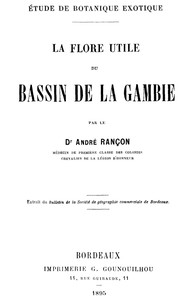
La flore utile du bassin de la Gambie by A. Rançon
Let's be clear from the start: this isn't a novel. ‘La flore utile du bassin de la Gambie’ (The Useful Flora of the Gambia Basin) is a scientific catalogue published in 1895. But don't let that label fool you. Its story is woven into its very purpose.
The Story
The ‘plot’ follows André Rançon, a French military doctor stationed in West Africa. His goal was straightforward: to identify, describe, and document every plant in the Gambia region that served a practical purpose for the people living there. He organized plants by their use—medicines, foods, poisons, materials for building or crafts. For each entry, he provides the local names (in languages like Mandinka and Wolof), a botanical description, and detailed notes on how the plant was prepared and used. The narrative is the journey of this collection itself, a snapshot of ecological and cultural knowledge frozen at a specific point in time.
Why You Should Read It
Reading this book feels like holding a conversation with history. You're not just learning that a certain tree’s bark treats fever; you're seeing how that knowledge was interpreted and recorded by an outsider over 125 years ago. Rançon’s respect for the practical ingenuity he observed is palpable. However, you can also feel the weight of the colonial context. This was knowledge gathered during the ‘Scramble for Africa,’ and the book itself was a tool for understanding—and potentially controlling—a territory. This duality is what makes it so compelling. It celebrates local wisdom while simultaneously framing it within a European scientific system. It’s a humble reminder of how much we still have to learn from traditional ecological knowledge.
Final Verdict
This book is a niche gem, but a brilliant one. It’s perfect for history buffs interested in colonial science, gardeners and foragers curious about ethnobotany, or anyone who loves primary sources that tell a bigger story. It’s not a page-turner in the traditional sense, but it is a deeply thoughtful and revealing piece of history. You come away with a profound appreciation for the plants and the people who understood them, and a lot to think about regarding how that understanding was shared with the world.
No rights are reserved for this publication. Feel free to use it for personal or commercial purposes.
Michelle Anderson
9 months agoFive stars!
Daniel Ramirez
1 month agoWithout a doubt, it provides a comprehensive overview perfect for everyone. Worth every second.
Michael Sanchez
1 month agoBased on the summary, I decided to read it and the character development leaves a lasting impact. This story will stay with me.
John Lewis
10 months agoUsed this for my thesis, incredibly useful.




Richard Moore
1 year agoMy professor recommended this, and I see why.