
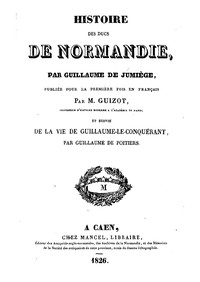
Histoire des ducs de Normandie, suivie de: Vie de Guillaume le Conquérant
Let's set the scene. It's the 1070s. William, Duke of Normandy, has just pulled off the impossible: he's conquered England and been crowned its king. His former chaplain, William of Poitiers, decides to write the official story. What follows is part history, part epic poem, and part love letter to his boss.
The Story
The book has two main parts. First, it traces the wild, violent history of the Dukes of Normandy, showing how William's ancestors built a powerful and feared state out of chaos. This is the backstory that makes William's rise possible. The second part is the main event: the life of William the Conqueror himself. William of Poitiers walks us through the Duke's troubled childhood, his fight to secure his own duchy, and the complex political web that led to his claim on the English throne. The climax, of course, is the Norman invasion of 1066—the preparations, the Battle of Hastings, and the brutal aftermath of securing a new kingdom. The narrative stops before William's later troubles, leaving us with the image of the triumphant king.
Why You Should Read It
You don't read this for a balanced, objective report. You read it to get inside the head of the winning side. The author's bias is the point. He wants you to see William as a brilliant, just, and divinely-supported ruler. Reading his passionate defense lets you feel the sheer audacity of the Norman project. You see how they justified their actions, how they built their legends, and how a court insider shaped the story for future generations. It's raw, unfiltered medieval thought. When he describes Harold Godwinson as an oath-breaker, you understand the Norman propaganda machine in full swing. It makes the distant past feel immediate and human, flaws and all.
Final Verdict
This is for the reader who wants to go beyond the textbook date of 1066. It's perfect for anyone fascinated by how history gets written by the victors, or for fans of shows like Vikings or The Last Kingdom who want the real, primary-source material. Be warned: it's a product of its time, with a very specific viewpoint. But if you pair it with a good modern introduction or translation notes, it becomes an incredibly rewarding experience. You're not just learning what happened; you're getting a front-row seat to how a king's story was crafted for the ages.
This historical work is free of copyright protections. Preserving history for future generations.






Amanda Lee
3 months agoSimply put, the depth of research presented here is truly commendable. Absolutely essential reading.